
Autism and Cerebral Palsy Treatment in China
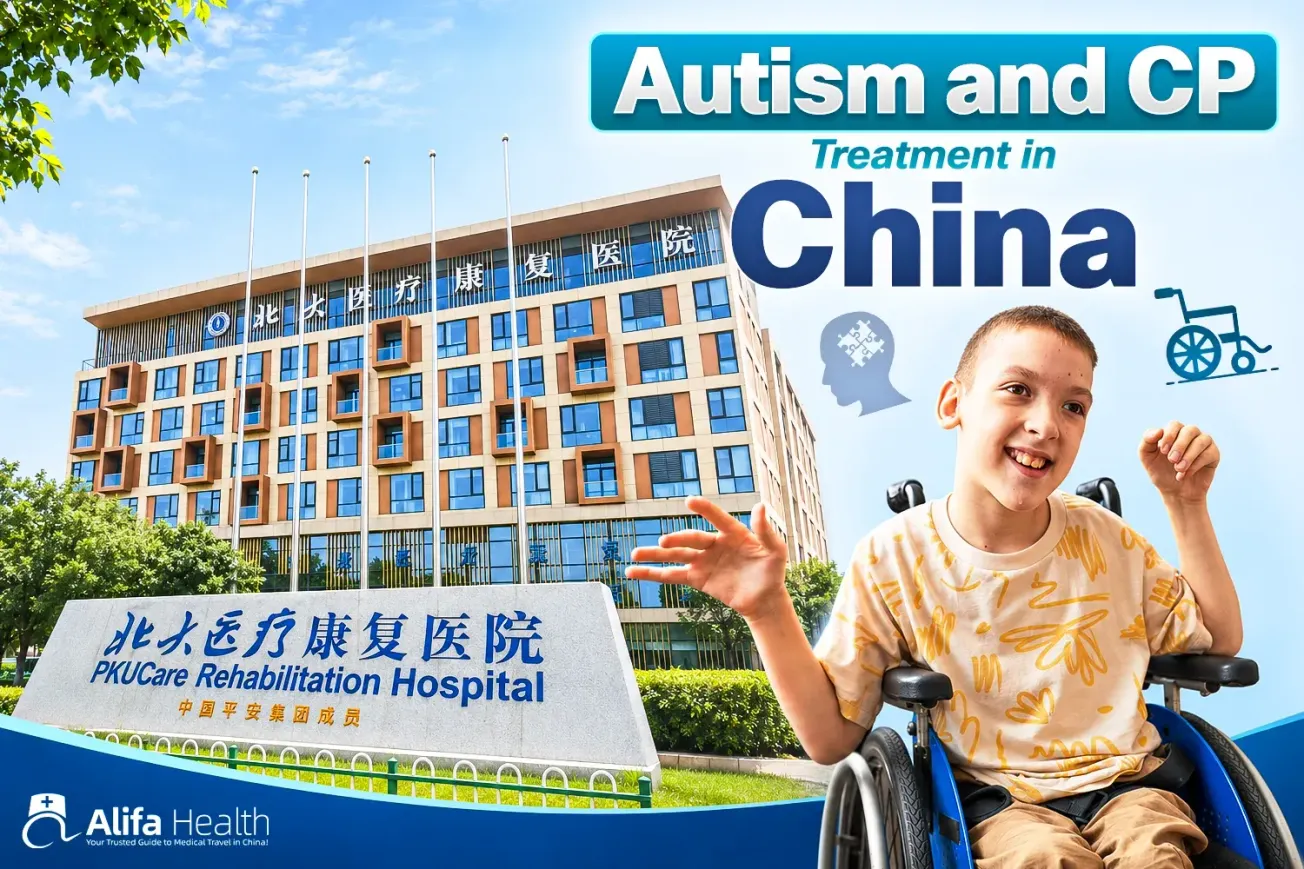
Children with autism or cerebral palsy can get rehabilitation at children's hospitals across China. On this page we list hospitals with national titles for children's care. We explain the care described by China's health regulator (NHC). We also show government prices. We also say what is not proven. We are not a hospital, and no treatment on this page is a cure.
Key points- We list 30 hospitals in 27 cities. Each holds a national title for children's care. Every title links to its source.
- Rehabilitation training is the main care for both conditions. For autism, China's 2026 guideline recommends at least 20 hours of support a week.
- At public hospitals in the four cities we checked, one day of therapy in our price examples costs RMB 150–402.
- Stem cell therapy is not an established treatment for autism or cerebral palsy.
How autism and cerebral palsy are treated in China
Autism
Autism (autism spectrum disorder) is a difference in how the brain develops. It affects how a child communicates and gets on with other people, and it often comes with repeated behaviours or strong, narrow interests. Signs usually show in the first years of life, and every child is different.
Medicine does not treat the main features of autism. Support can help children build skills for communication and daily life. China's guidance recommends starting early, before age 6 if possible [1]. Older children can still benefit. China's 2026 guideline recommends at least 20 hours of support a week. It says support often lasts several years. Families can practise skills at home with guidance from the care team. Ask the team how home practice fits your child's plan [2].
Medicine can help with some problems that occur alongside autism, such as sleep problems. A doctor can check the cause and discuss whether medicine may help [1] [2].
Cerebral palsy
Cerebral palsy is a group of disorders that affect movement and posture. It comes from damage to the developing brain before, during or soon after birth. The brain damage does not get worse over time, but its effects can change as a child grows. Some children also have problems with speech, eating, seeing, hearing or learning.
Children with cerebral palsy can get help with movement, daily tasks, speech and communication. A care team helps each child set goals. For some children, specialists may also suggest injections for tight muscles or surgery [3] [4]. A national Chinese-medicine treatment plan for cerebral palsy has been issued [5]. This comes from China's Chinese-medicine administration (NATCM).
How we choose these hospitals
A hospital is listed here only if it holds one of these government titles for children's care.
Swipe the table sideways to see all columns.
| National title | Chinese wording | Given by |
|---|---|---|
| National Children's Medical Centre | 国家儿童医学中心 | National Health Commission (NHC) |
| National Regional Medical Centre for Children | 国家儿童区域医疗中心 | NHC |
| National regional medical centre project (paediatrics) | 国家区域医疗中心(儿科) | National Development and Reform Commission and NHC |
| National Clinical Key Specialty in child rehabilitation, paediatric neurology or child health care | 国家临床重点专科 | NHC (wording exactly as the hospital publishes it) |
A key specialty in rehabilitation medicine also counts when the hospital's own page shows rehabilitation for children with cerebral palsy or autism. The list is grouped by city, and it is not a ranking. Hospital names are shown in English and Chinese. We do not list a hospital because an agency or an advert names it.
Hospitals by city
Cities with flights from our main patient markets come first (Beijing, Shanghai, Guangzhou, Kunming, Harbin, Urumqi), then the others from A to Z. Every title links to its source. Each rehabilitation entry links to the hospital's own page.
Swipe the table sideways to see all columns.
30 hospitals in 27 cities; the most a condition page lists is 30.
Other hospitals families ask about
Families also search for these hospitals by name. They are not in the list above because they do not hold one of the national titles the list uses.
Swipe the table sideways to see all columns.
Rehabilitation
Rehabilitation is the main care for both conditions. It is training, given by therapists, that helps a child move, talk, play and look after themselves. Parents usually take part and learn to carry on the training at home [1].
Chinese hospitals bill each kind of training by name. The table below shows the names you will see on a bill, so you can match them to what your child receives.
Swipe the table sideways to see all columns.
| Training | Name on a Chinese hospital bill | Meaning |
|---|---|---|
| Movement training | 运动功能训练 | Exercises for the arms, legs and body (physiotherapy). |
| Daily-living skills training | 生活技能康复训练 | Practice in everyday tasks such as eating and dressing (occupational therapy). |
| Speech training | 言语功能训练 | Help with speaking, language and understanding. |
| Training for developmental conditions | 神经发育障碍康复训练 | One-to-one or group training for children with autism and other developmental conditions. |
| Development and movement assessments | 神经发育障碍检查 · 运动功能检查 | Tests that measure where a child is now, used to plan the training. |
How long care lasts varies with each child's goals and needs. For autism, China's 2026 guideline recommends at least 20 hours of support a week, often for several years [2].
Treatments available in China
For autism
Support that builds communication and daily-life skills is the main care. China's guidance recommends starting early, before age 6 if possible [1]. Older children can still benefit. Medicine can help with some problems that occur alongside autism, such as sleep problems. It does not treat the main features of autism [1] [2].
For cerebral palsy
Rehabilitation training is the main treatment that the hospitals in our list publish. For children with cerebral palsy whose tight muscles cause problems with movement or care [4], some hospitals use botulinum toxin type A. It can ease tightness for a time and is used alongside therapy. Ask the hospital to confirm the approved use in China for the exact product and your child's age. One hospital describes an operation called selective dorsal rhizotomy (SDR) on its own pages [6]. Specialists may consider it for some children with spastic cerebral palsy, which causes tight muscles. The team assesses whether it might help the child walk and plans therapy after surgery.
Chinese medicine
China's newest national guideline on autism support (2026) asks for methods with clear scientific evidence. The methods it lists are behaviour-based, and it does not name acupuncture or herbal medicine [2]. The 2022 national standard on screening and support for young children does not name them either [1].
For cerebral palsy, China's 2022 rehabilitation guideline from national rehabilitation societies has a chapter on Chinese medicine [7]. It covers Chinese massage, acupuncture, moxibustion, herbal medicine and herbal baths. It says these are used alongside rehabilitation training: movement training is the core of care, and herbal medicine alone does not follow this principle. A national Chinese-medicine treatment plan for cerebral palsy has also been issued [5]. This comes from China's Chinese-medicine administration (NATCM).
What is not established care
Stem cell therapy is not an established treatment for autism or cerebral palsy. China's drug review centre lists permission for a clinical trial in autism [8]. A trial tests a treatment. China has also approved a stem cell medicine for a complication after a transplant [9]. That approval covers the transplant complication.
Reviewed by Dr. Arif Shah, MBBS · 2026-11-18.
Cost: worked examples from government prices
These are the most a public Class 3 hospital may charge, set by each city's medical insurance bureau. Prices are in yuan (RMB). Each example shows what one day of therapy costs on these prices. It is not your bill, and your child's doctor decides what training your child gets.
Swipe the table sideways to see all columns.
| Item (unit) · price in RMB | Beijing (from 2026-12-19) | Shanghai | Guangzhou | Tianjin |
|---|---|---|---|---|
| Movement training (half hour) | 106 | 87 | 84 | 70 |
| Daily-living skills training (half hour) | 100 | 68 | 84 | 30 |
| Speech training (half hour) | 90 | 60 | 84 | 65 |
| Training for developmental conditions, one-to-one (half hour) | 84 | 45 | 84 | 70 |
| Training for developmental conditions, group (half hour) | 28 | 33 | 48 | 40 |
| Development assessment (each) | 29 | 30 | 28 | 35 |
| Movement assessment (each) | 58 | 52 | 48 | 45 |
| Psychological therapy, one-to-one (half hour) | 146 | 67 | 150 | 110 |
| Hospital bed, three-person room (per day) | 70 | 68 | 69 | 64 |
Each city limits how much training is billed in a day. In Beijing, movement training is billed for up to 3 hours a day and the other training for up to 1 hour each. Shanghai has a daily cap per item. For movement training, the cap is RMB 450. In Guangzhou and Tianjin, movement training is billed for up to 100 minutes a day. Daily-living, speech and developmental training are billed for up to 1 hour each.
Example 1: one day of therapy for cerebral palsy
This price example uses 60 minutes of movement training, 30 minutes of practice with daily tasks and 30 minutes of speech training. Your child's care team will choose the sessions and how long they last.
Swipe the table sideways to see all columns.
| City | Training for one day (RMB) | Bed, if admitted (RMB) |
|---|---|---|
| Beijing (from 2026-12-19) | 402 | 70 |
| Shanghai | 302 | 68 |
| Guangzhou | 336 | 69 |
| Tianjin | 235 | 64 |
Example 2: one day of therapy for autism
This price example uses 60 minutes of one-to-one support (training for developmental conditions) and 30 minutes of speech training. The mix and length of sessions will depend on your child's needs and the care team's plan.
| City | Training for one day (RMB) |
|---|---|
| Beijing (from 2026-12-19) | 258 |
| Shanghai | 150 |
| Guangzhou | 252 |
| Tianjin | 205 |
This price example counts each listed assessment once at the start. The team may repeat a check to see how your child is doing or to update the care plan. Ask which assessments your child may need and when. In Shanghai, for example, a development assessment and a movement assessment together cost RMB 82. The examples show no medicines. China's 2026 guideline recommends at least 20 hours of support a week [2]. Families can practise skills at home with guidance. Ask the care team which activities fit your child's plan and which hospital sessions you would pay for. Always check the fee in the hospital's WeChat mini-program before you pay.
Planning your treatment trip
- Prepare your records. Gather your child's medical records and any test results, and have them translated.
- Choose a hospital and contact it. Use the hospital table above. To see which hospitals list services for international patients, use our international patient services table.
- Get your visa. China has no special medical visa. Most patients use an S2 visa with an invitation letter from the hospital (our visa guide is linked below this page).
- Plan how long you stay. Ask your child's care team how long you need to stay. Care may continue after the trip. Ask which sessions need to take place at the hospital and what support can continue closer to home.
- Plan how to pay. Hospitals usually ask for a deposit before a stay (our guide to paying at hospitals is linked below this page).
- Get language help. Our guide to medical interpreters is linked below this page.
- Going home. Before you go home, ask for a written summary and a home training plan.
Information only: this page is not medical advice and does not recommend any hospital.
Frequently asked questions
How much does rehabilitation cost for a foreign child?
We checked four cities. At public Class 3 hospitals there, 30 minutes of movement training costs at most RMB 70–106. In total, one day of therapy in our examples costs RMB 150–402. These figures are not a bill, and your child's doctor decides the plan.
Is treatment free for foreign children in China?
No. Families apply for China's rehabilitation aid for children with disabilities through the local disability federation. It is the federation where the child's household registration or residence permit is held. Families who come to China for treatment pay the hospital themselves [10].
Does Chinese medicine or acupuncture help children with autism?
We do not know whether acupuncture or herbal treatments help with autism. China's national guidelines on autism support do not name them [1] [2]. The main support helps children build communication and daily living skills.
Is there a cure for autism?
There is no cure for autism. Support can help children communicate, learn and take part in daily life. Starting early can help, and older children can benefit too [1].
Can a child with cerebral palsy recover?
Cerebral palsy is lifelong. A child's abilities and support needs can change over time. Therapy can help with movement, communication and daily tasks. Each child's progress is different.
How is cerebral palsy treated, and does physiotherapy help?
Physiotherapy can help a child practise useful movements, such as sitting, standing or walking. The therapist sets goals with the child and family. Some children also get help with daily tasks, speech or communication.
Is there surgery for cerebral palsy?
Yes. A specialist team may suggest surgery for some children. Tightness in the legs can be reduced [6] by an operation called selective dorsal rhizotomy (SDR). Other surgery can address some problems with muscles, bones or joints. The team checks what may help and plans therapy after surgery.
Muscle injections for cerebral palsy: do they help?
In some children with cerebral palsy, tight muscles can ease for a time after injections of botulinum toxin type A. This can help with movement, comfort or daily care. Therapy continues. A specialist checks how well it worked before deciding whether to repeat it. Ask which uses are approved in China for the product and age group.
What medicine is used for autism?
Medicine does not treat the main features of autism. A doctor can assess other health problems and discuss treatment. China's national standard says there is still no medicine for the core features of autism. Children with severe emotional or behaviour problems, or other conditions, should see a specialist. The specialist chooses any medicine [1]. China's 2020 national standard for mental disorders says education and rehabilitation come first. It says medicine may be used in two situations. The first is when serious mood swings, self-harm, aggression or destructive behaviour continue, and behaviour therapy has not worked or is not available. The second is when another mental disorder is present. It does not usually advise psychiatric medicines for children under school age [11].
Are stem cells an approved treatment in China?
Stem cell therapy is not an established treatment for autism or cerebral palsy. China's drug review centre lists permission to study a stem cell product in an autism trial [8]. Permission to run a trial does not mean the product is approved to treat autism.
How do we come to China for treatment, and which visa do we need?
China has no special medical visa. Most patients use an S2 visa with an invitation letter from the hospital (our visa guide is linked below this page).
Why don't we publish reviews or success stories?
There is no cure for autism or cerebral palsy, and every child's progress is different. So one family's story cannot tell you what will happen to your child. Instead, we show which government titles each hospital holds, and our How we verify page explains how we check our facts.
Medical answers reviewed by Dr. Arif Shah, MBBS · 2026-11-18.
Get help choosing a hospital
Tell us your diagnosis and recent test results. Our care team will suggest suitable hospitals from this list, explain the likely costs, and can arrange a medical interpreter in 48 Chinese cities.
WhatsApp and Telegram: +86 135 2232 3808. You can also use the live chat on this site at any time. We guide and arrange; treatment decisions stay with you and your doctors.