China has no visa type called a "medical visa". The usual route for treatment is the S2 visa, which visa centres use for "other private affairs", including medical matters. The 30-day visa-free entry rule does not list medical treatment. Hainan is the one exception: its 30-day visa-free entry names medical treatment, but it covers Hainan only. The hospital that will treat you writes your invitation letter.
| Route | Stay allowed | Names medical treatment? | Rule dated |
|---|---|---|---|
| 30-day visa-free entry | Up to 30 days | No | Notice of 3 November 2025; runs until 31 December 2026 |
| 240-hour visa-free transit | Up to 10 days, in set areas | No | Rule page of 20 August 2026 |
| Hainan 30-day visa-free entry | Up to 30 days, Hainan only | Yes | Updated on 20 August 2026 |
| S2 visa | Up to 180 days for a short stay | Visa centres give medical matters as an example | Visa centre list of 26 April 2024 |
| Port visa (口岸签证) | Up to 30 days, one entry | No, it names humanitarian reasons | Law in force since 1 July 2013 |
Two ways in: visa-free or a visa
Your passport decides your first step. Some passports can enter China without a visa for a short stay. Other passports always need a visa before travel.
Visa-free entry has a fixed list of allowed purposes. Medical treatment is not on that list, except in Hainan. So most patients apply for a visa, even when their passport allows visa-free entry for tourism.
You can check whether your country is on the visa-free list in our list of visa-free countries. This guide explains the rules, not the list.
Visa-free entry and medical treatment
The 30-day visa-free rule
The Ministry of Foreign Affairs extended this rule on 3 November 2025. People from the listed countries with an ordinary passport can stay up to 30 days. The allowed purposes are business, tourism and sightseeing, visiting family and friends, exchange visits and transit. Medical treatment is not one of them.
The notice says the rule runs until midnight on 31 December 2026. We found no official statement yet about what happens after that date.
The 240-hour transit rule
Since 20 August 2026, this rule covers people from 57 countries. You must travel on to a third country with a ticket for a fixed date. You may stay up to 10 days in set areas of 24 provinces. The allowed activities are tourism, business, visits and family visits, and medical treatment is not named.
Hainan: the one route that names treatment
Hainan island has its own 30-day visa-free entry for people from 61 countries. The National Immigration Administration lists medical treatment (就医) among its purposes. You must enter through a Hainan port and stay inside Hainan province. This route does not let you travel to a hospital in another province.
The S2 visa for medical treatment
Chinese rules describe the S2 visa as a visa for short family visits and for "other private affairs". A short stay means 180 days or less. The rules themselves do not name medical treatment.
The official visa centres give the examples. The visa centre in Edinburgh lists lawsuits, inheritance, medical matters and property among these private affairs. So a patient usually applies for an S2 visa.
The invitation letter
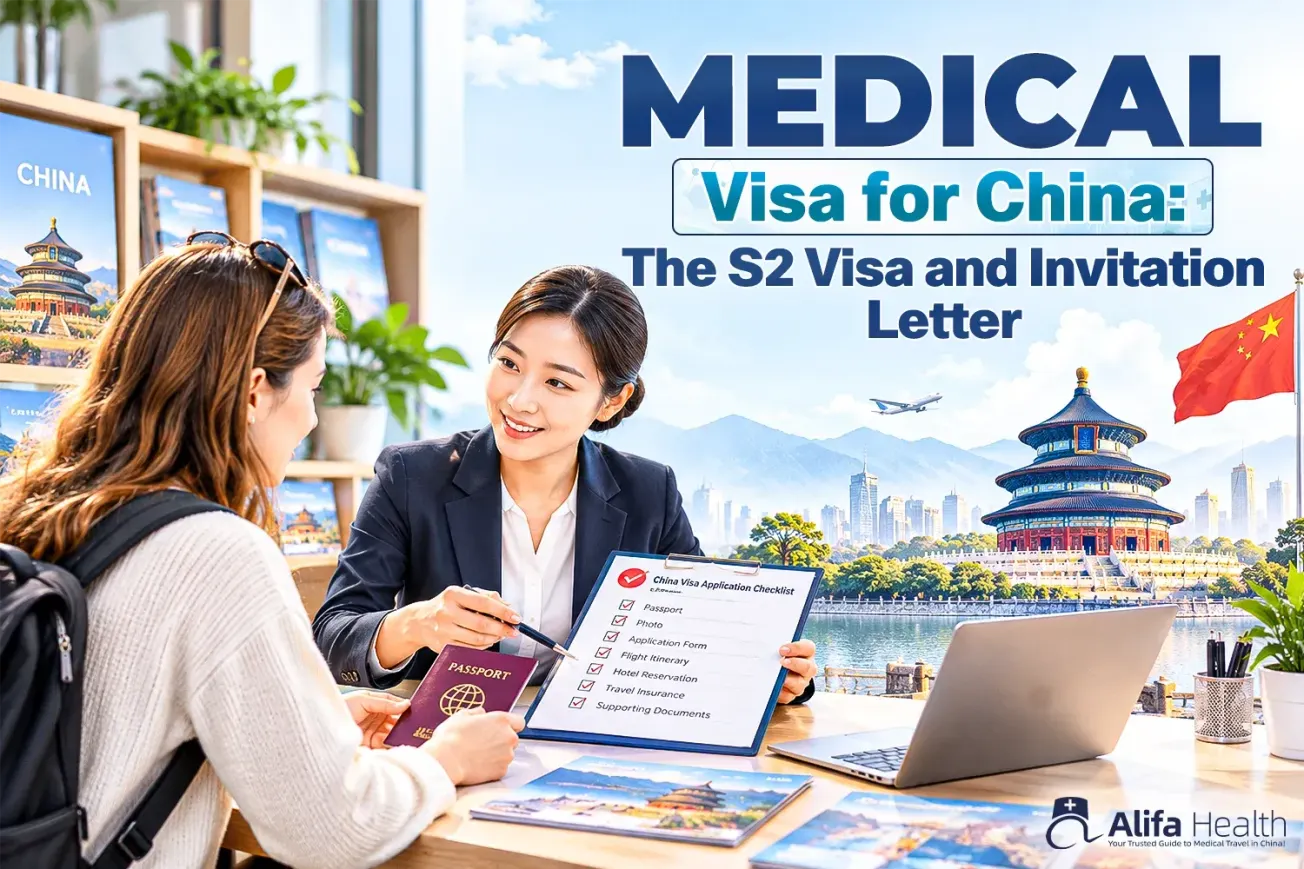
The visa centre in Almaty lists what a patient must add to an S2 application. The hospital in China that will treat you must give an invitation letter, a hospital admission letter or a letter saying it will accept you. A fax or a copy is accepted. The same page also asks for an original bank statement showing at least USD 10,000.
An invitation letter must give your name, sex and date of birth. It must also give the reason for your visit, your dates, the places you will visit and who pays. Finally, it must give the hospital's name, phone number, address, stamp and the signature of its legal representative.
Each country's visa centre or embassy can ask for different papers. Please check the list of the visa centre that serves your country before you apply.
Family members who come with you
A family member who travels with you also applies for an S2 visa. The Almaty visa centre allows only family members, not friends or paid carers. It says no more than two should come, in principle. Each one needs proof of the family link and a carer letter from the same hospital.
Staying longer than planned
Treatment can take longer than you expect. China's exit and entry law lets you ask for more time. You apply to the exit and entry office of the local public security bureau. You must apply at least seven days before your permitted stay ends.
For an S2 visa held for private affairs, the National Immigration Administration says an extension can be up to 90 days. You must show papers about your private affairs or your humanitarian reason. The total extension cannot be longer than the stay first shown on your visa.
If you came in visa-free, you apply for a stay permit (停留证件) instead. This permit is valid for up to 180 days. For a longer residence permit, a 2013 notice asks for a hospital letter showing at least six months of hospital stay or medical care.
The office gives you a receipt that is valid for up to seven days. It decides on your request within that time. Approval is not automatic, so please apply early.
If you must travel urgently
China's exit and entry law allows a port visa for people who must enter urgently for humanitarian reasons. You need a letter from the relevant Chinese authority that agrees you may apply at the port. Only ports approved by the State Council issue it.
A port visa allows one entry and a stay of up to 30 days. The law does not name medical treatment as a reason. Please do not plan a hospital trip around this route.
Applying from Bangladesh
Dhaka has its own steps for medical visas. Since 27 July 2025, medical visa applicants do not book an online interview. After the online check, you take the first page of your application form to the Chinese Embassy. You go on a working day before 9:50 in the morning.
If you pass the interview, the embassy stamps your form. Then you hand in your papers at the medical window of the Chinese Visa Application Service Centre in Dhaka.
On 12 September 2025, the embassy listed the papers for an S2 medical visa. They match the Almaty list: the hospital letter, a bank statement of at least USD 10,000 and no more than two family carers in principle. We found no special medical visa steps for Pakistan, Kazakhstan, Uzbekistan, Mongolia or Nepal.
Visa agents and fake messages
The Chinese Embassy in Bangladesh warns people not to trust agents who say the visa is hard to get or who ask for high fees. It says it has not named any agency to handle visas for it.
The Chinese Embassy in Italy warns about fake calls and messages. Embassies and visa centres never ask you by phone, text or email to pay extra visa fees. Do not send money to anyone who asks this.
Using false papers to get a visa is against Chinese law and can lead to a fine. Only use a letter that the hospital itself has written.
What changed recently
On 3 November 2025, the 30-day visa-free rule was extended to 31 December 2026. On 20 August 2026, two more countries joined the transit rule and the Hainan rule. Since 27 July 2025, Dhaka has had a separate window for medical visas.
In March 2026, nine national bodies published a plan to bring more visitors to China. It supports international medical tourism and names the Boao Lecheng International Medical Tourism Pilot Zone in Hainan. It also says China will study an electronic visa.
Planning to pay for treatment? Read our guide to paying at Chinese hospitals. For language help, see our guide to medical interpreters. To find hospitals that list services for patients from abroad, use our table of international patient services.
Common questions
Is there a medical visa in China?
No, Chinese rules have no visa type with that name. Visa centres place medical treatment under the S2 visa, as one of the "other private affairs".
Can I come visa-free for treatment?
The 30-day visa-free rule does not list medical treatment as a purpose. Only Hainan's visa-free entry names it, and you must stay in Hainan.
Who writes the invitation letter?
The hospital in China that will treat you writes it. It can also give an admission letter or a letter saying it will accept you.
How many family members can come with me?
The visa centre in Almaty and the embassy in Dhaka say no more than two, in principle. They must be family members, not friends or paid carers.
Can I stay longer if my treatment takes more time?
Yes, you can apply for more time at the local exit and entry office. You must apply at least seven days before your permitted stay ends.
Can Alifa Health promise that I will get a visa?
No, we cannot promise a visa. The embassy or visa centre decides on every application.